


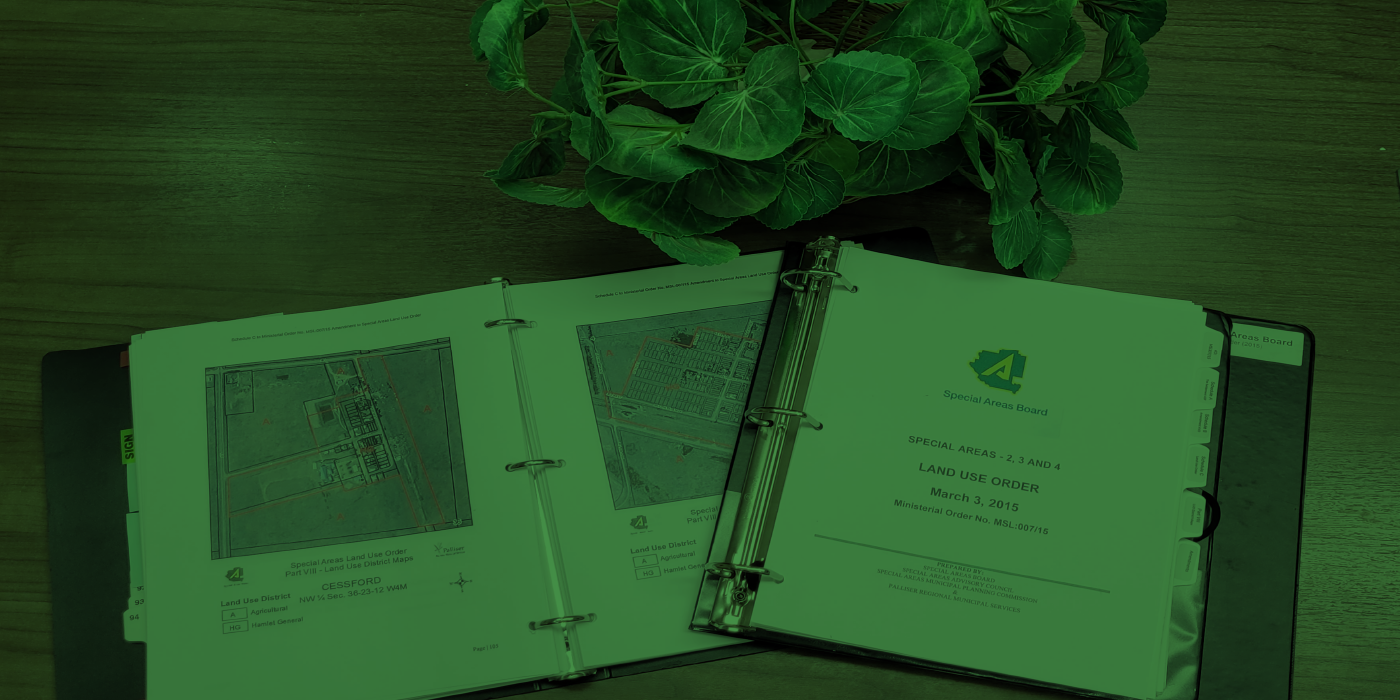
Land Use Order Review
Special Areas recognizes the value of public consultation as part of the municipal decision-making process and is committed to creating opportunities for meaningful public participation in municipal decisions that directly impact the public. We’re all neighbours, and all need to have a say on issues that affect those of us who live and work in the Special Areas.
The Special Areas Board is updating the Land Use Order. As a part of our public participation process, we requested feedback on changes proposed to the Land Use Order. First reading of the proposed Land Use Order has been held, and a public hearing was held on March 12, 2024 in Youngstown, AB. Feedback collected during the public engagement and formal consultation process is currently being considered by the Board.
KEY CONTACTS
Maeghan Chostner, Communications Officer
403-854-5611
public.input@specialareas.ab.ca
Important Documents
CURRENT MATERIALS
Special Areas 2, 3 and 4 Land Use Order – MO MSD:064/24 – SIGNED
Public Consultation Report – September 2024 (Ministerial Order Signed)
ARCHIVED MATERIALS
Public Consultation Report – Special Areas Land Use Order – May 2024
Public Hearing Advertisement – March 12, 2024
What We Heard Report – Fall 2023 Engagement Summary
What We Heard Report – January 2024 (includes changes made to LUO based on public feedback)
Special Areas Land Use Order (first reading January 2024)
Summary of Major Changes to LOU (fall 2023)
Why was the Land Use Order Reviewed?
The Special Areas Board updated the Special Areas Land Use Order to streamline regulations, reduce red tape, and help support clear and understandable development processes in the Special Areas.
The Special Areas 2, 3, and 4 Land Use Order was approved via Ministerial Order on August 24, 2024. Feedback from the public and other stakeholders helped inform changes to the Land Use Order document. A copy of the public consultation report is available here.
The previous Land Use Order was last updated in 2015 and needed to be reviewed to make sure it aligned with recent legislative changes and Special Areas Board’s Municipal Development Plan (MDP). Updating the Land Use Order helped make sure it was more flexible and is easier to use for everyone. The process to update the Land Use Order first began in 2021 and was completed summer 2024.
Some of the goals of the Land Use Order review included:
- Reducing red tape
- Making it easier to read and understand by all users
- Aligning it with recent legislative changes and the MDP
- Encouraging more subdivision and streamlining development processes
The Land Use Order review was led by Special Areas Administration, and the project team includes representatives from Property Administration, Development Officers, and planning staff from Palliser Regional Municipal Services. This process took into consideration a wide variety of current and potential uses by businesses and residents in the Special Areas.
What is the Land Use Order?
The Land Use Order is a document that regulates development within the Special Areas. Every municipality in Alberta is required to have one under the provincial Municipal Government Act. It categorizes all properties in the municipality into various land use districts and prescribes how land and buildings can be used in those districts. It establishes a system for issuing development permits and talks about the appeal process.
The Land Use Order helps ensure neighboring land uses are compatible with each other and that what one person does on their property does not negatively impact their neighbours. It considers things like:
- Types of buildings and activities on a property
- What can be built on a property and where it can be built
- Density of development on a property
Frequently Asked Questions
What is a Land Use Order?
The Land Use Order is a document that regulates development within the Special Areas. Every municipality in Alberta must have one under the provincial Municipal Government Act. It categorizes all properties in the municipality into various land use districts and prescribes how land and buildings can be used in those districts. It sets up a system for issuing development permits and talks about the appeal process.
Why do we need a Land Use Order?
The Alberta Municipal Government Act requires all municipalities in Alberta to adopt a Land Use Bylaw. This document regulates the use and development of land and buildings within the municipality. In the Special Areas, we use ministerial orders in place of bylaws as we are a crown agency established by the Special Areas Act.
How does the Land Use Order affect me?
The Land Use Order regulates development in the Special Areas. If you are planning to construct a building, change land use (zoning), undertake redevelopment, erect signs, or subdivide land, the Land Use Order will help you understand any rules and regulations you need to consider.
A good place to start is to find out what the current land use (zoning) is, and what the permitted and discretionary uses are for that type of land district. You can find land use district maps in the draft Land Use Order.
The next step is to figure out what use(s) exist on your property. If a use is not listed as either permitted or discretionary for that land use district, it is prohibited by the Land Use Order unless protected by law. Another step is to review your Real Property Report (RPR). This report shows you where your buildings are in relation to property lines. This will let you review property setbacks and site coverage requirements.
What is zoning and how does it affect me?
The Land Use Order classifies parcels of land into Land Use Districts. This is also known as zoning. There are seven types of land districts included in the proposed updated Land Use Order:
- Agricultural (A)
- Grouped Country Residential (GCR)
- Hamlet (H)
- Rural Commercial (RC)
- Rural Industrial (RI)
- Rural Mixed-Use (RMU)
- Airport Vicinity Overlay (AVO)
The Land Use Order outlines the rules for development of land in the Special Areas for each district (zone) as well as the process for making decisions for development permit applications. Each district (zone) has its own set of regulations which include a list of permitted and discretionary uses.
Examples of regulations in land use districts can include things like number of dwellings on a property, setbacks from property lines, and separation distances between uses.
What is a permitted use and what is a discretionary use?
In the Land Use Order, a “permitted use” means the use of land or a building which is listed as Permitted in a Land Use District and for which a Development Permit must be issued, with or without conditions, by the Development Authority, if the proposed Development meets all requirements of the Land Use Order.
A “discretionary use” means the use of land or a building for which a Development Permit may be issued by the Development Authority, with or without conditions.
Translation? Permitted use means a development permit must be issued if development meets requirements. Discretionary use means a development permit may be issued (or refused) or referred to the Municipal Planning Commission for review. In both cases, conditions may or may not be attached to the development permit.
Each land use district lists permitted uses and discretionary uses, as well as instances when a development permit is not required in that type of land district.
What is a development permit and how is one approved?
A development permit is defined as a document authorizing development issued under the Land Use Order. It considers the what and where of a potential project or development. This is a different document than a building permit, or other permits issued by safety code officers. In the Special Areas, building permits and other safety code permits are managed through Palliser Regional Municipal Services.
In the Special Areas, each district office manages development in that area. Every Special Area has a Development Officer appointed by the Board to perform Development Authority duties.
How do I know if I need a development permit?
In the Land Use Order, development permits are not required for some types of developments. These include things like:
- Extensive agriculture
- Day home
- Home occupation
- Non-structural alterations
- Landscaping
- Patio/deck
- Fences (as per Section 9.10)
- Small accessory building in hamlets
- Accessory buildings/agricultural buildings (Agriculture District)
- Some signs
You can find a detailed list of these in Section 1.11 of the Land Use Order.
I want to start a home business - do I need a permit?
The Land Use Order document clarifies that most home-based businesses do not require a permit from the Special Areas. Some larger home-based businesses may require a permit, depending on the size and location of that business.
There are three types of home businesses (called home occupation) in the Land Use Order:
- Home Occupation – Phone & Desk (no permit required)
- Home Occupation – Minor (permit only required in hamlet)
- Home Occupation – Major (permit required in all zones)
Contact your local Development Officer to learn more.
What is a subdivision and how is one approved?
A subdivision is defined as the division of a parcel of land by an instrument or dividing a parcel of land and obtaining separate legal titles.
Palliser Regional Municipal Services acts as the Subdivision Approving Authority for the Special Areas. This means Palliser Regional Municipal Services processes all subdivision files for the Special Areas Board and provides recommendations for decisions on subdivisions to the Board.
Subdivision services provided by Palliser Regional Municipal Services includes all aspects of the subdivision process including advice and discussions with applicants including application review, circulation process, subdivision report and recommendations, circulation of decision document and final endorsement procedures.
Learn more about subdivision in the Special Areas by visiting https://www.palliserservices.ca/subdivision.
What changed in the updated Land Use Order?
Changes to the Land Use Order have been made to make this document more flexible and easier to use for everyone.
Some of the major changes include:
- Aligning the Land Use Order with recent legislative changes and the Special Areas Board’s Municipal Development Plan (MDP)
- Reducing red tape by adding more types of developments that do not need a permit including secondary suites, day homes, decks (up to 150 ft2), demolitions, accessory buildings outside hamlets, and some signs
- Allowing more subdivision and development without re-zoning including two dwelling units per parcel (up to three parcels per quarter section) for Agricultural Districts
- Increasing flexibility of development in hamlets by combining four hamlet districts into a single hamlet district that blends residential, commercial, and industrial uses
- Simplifying regulations for renewable energy development by removing anything that is already regulated by the Alberta Energy Regulator (AER)
One of the most important goals of the Land Use Order update was to make it easier to read and understand by all users, and to streamline development processes in the Special Areas.