


08 Jul 2026 BMO Farm Family Award Winners
Congratulations to all the families in Special Areas who received the 2026 BMO Farm Family Award.
Special Area No. 2 – WaltonFamily (Walton Land & Cattle)
Special Area No. 3 – Andrew Family (Andrew Ranches)
These families are nominated by their local Agriculture Service Boards. Every year the Calgary Stampede and the Bank of Montreal recognize outstanding farm families in southern Alberta. These families were invited to receive this award at the Calgary Stampede.
To find out more about the Farm Family Awards, visit: https://ag.calgarystampede.com/events/bmo-farm-family-awards
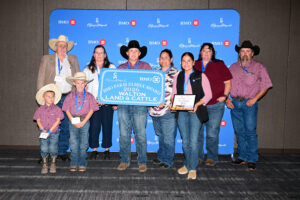
Special Area No. 2 – Walton Land & Cattle
Ron Walton has a renewed appreciation for the simple pleasures of the land and the ranching lifestyle. After spending three months in the city recovering from a serious accident in 2022, Ron was reminded of the everyday joys of country living. “Even getting home and smelling the cow manure was just unbelievable,” remembers Ron. “Today, I can just look out at the dry grass and be 100 per cent content.” Ron and his family are the 2026 BMO Farm Family from Special Area No. 2.
The Waltons have always been focused on the preservation of the natural resources and inhabitants of their land. This balanced mindset has been a key part of their ranching practices over the years. “Nature is a big thing. I think of it as we are farming nature,” states Ron. “If one is successful, then the other will be too.”
The Walton family ranch was homesteaded in 1911 by Ernest Walton, who came from Hamilton, Ontario. Ernest had developed asthma from the silver particles in the book bindings in the bookstore he ran and as a result headed to southern Alberta for some fresh air, working with his team of horses to haul dirt out of the basement of the new Hudson Bay store in Calgary. Through co-workers, he heard there was land east of the city and headed to claim some of his own, where he built a sod shack, and later, his brother and sister joined him. Ernest met his wife, Winifred Crossly, and they married in 1923. Ron’s maternal grandfather had come from Belgium and worked at the Bassano dam before he headed to the eastern part of the province. Eventually, in 1947, Ernest retired and relocated to British Columbia due to his health, and his son, Robert, took over the farm.
Robert’s son, Ron, also became involved at 15 and officially took over the farm after his father died in 1985. Ron and his wife, Kim, have since been joined by their son, Tyler, and daughter-in-law, Dezarae, along with their young children. Tyler and Dezarae operate as Walton Cattle Co. Ltd. Tyler returned to work full-time on the farm after his father’s accident in 2022 and has quickly taken on many responsibilities. Ron and Kim’s daughter, Ashley Walton, and her children are also involved, helping with yard care and showing 4-H cattle from the ranch.
Raising commercial cattle has been at the core of Walton Land & Cattle since its inception. However, in 1969, Ron’s father, Robert, started breeding Simmental through artificial insemination in a community pasture in 1969. The family has stayed with the Simmental breed since the 1970s. Ron was able to transfer his father’s early membership CSA number to Robert’s youngest great-grandson, Quaid Walton. Ron’s grandchildren are the fifth generation on the farm. In the mid-1970s, Ron became attracted to Pinzgauer cattle and showed them very successfully through the 1980s with Kim by his side. Their herd was dispersed in the early 1990s, and they focused on their Simmentals thereafter.
Today, the Waltons run a cow-calf operation with a Simmental base, influenced by Red Angus, Black Angus and Fullblood genetics. Calving begins in mid-March; six weeks later, they separate the 300 pairs and 100 yearling heifers into six breeding units, dispersing them across spring and summer pastures with assigned bulls. The Waltons developed this breeding unit system to help extend the working life of their bulls. “Rather than just selling the bulls, we transfer them into different pastures to run with different cow groups so we can use them for seven to eight years to help save money on buying new ones,” explains Ron. Each fall, they sell feeder steers and bred heifers, while keeping select replacement heifers for their own herd.
Walton Land & Cattle still operates as a mixed operation. However, an increasingly dry climate has influenced the family’s operating decisions, infrastructure and the evolution of the ranch. In 1991, Ron led an integral water infrastructure project involving 10 to 12 farms. Together, they filled 51 dugouts, added water to several dams and lifted and laid 50 miles of pipe to provide water more efficiently to each farm. Today, they have their own water security, with 13 miles of underground pipes and 28 water tanks they have built since then. With this infrastructure, they can pipe water to all their pastures and keep it clean for their herd. In addition, during the four-year drought and grasshopper infestation of 2000-2004, they decided to stop growing crops and maintain the balance of their land as either grassland or reseeded for hay. They continue to maintain this practice today, reseeding about 300 acres per year and keeping it for three years before returning it to grass. Each of their pastures is only grazed once a year by their herd.
In addition to caring for their cattle and natural resources, the Waltons work hard to preserve the land and give back to their community. A special focus of their operation has been to continue providing places for wildlife to thrive. By not allowing hunting and refraining from using fertilizer, herbicides and limiting pesticides on their land, they have naturally created a haven for these creatures, including elk, antelope, mule deer, foxes, prairie chickens and more. “These practices have made the animals want to be here because it is an environment they want and they can find food and water easily,” reflects Ron. “It is so rewarding to see them drink from the tanks.”
In the community, Ron served as a 20-year 4-H Beef leader and was a member of the Homestead Coulee Community Club and the Handhills Community Association for 15 years. Starting his tenure as a 4-H leader before his kids were old enough, Ron found great joy in seeing his club members succeed in their projects. He was also the founder of a new carcass class for the East Central District during his time as a leader. Kim is an avid member of the quilting community.
For Ron, it is all about the simple pleasures — his family, the ranch and the wildlife that call it home. When these three work in harmony, he couldn’t be more grateful. “When I see the animals here, I feel that something is right and the system is working the best it can,” he states.
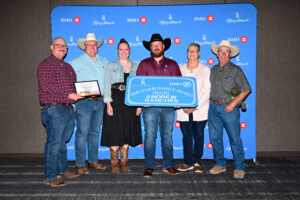
Special Area No. 3 – Andrew Ranches
Each year the Andrew family hosts a two-day trail ride pushing 200 pairs of cattle from their homeplace to summer pasture 32 miles away, and then back home again in the fall. They have maintained this bi-annual tradition for the last 40 years and from it, have fostered many relationships and special memories, while maintaining the roots of their past. “We have had people come out from Toronto, Indiana, Wales and Australia, as well as some who are now the second-generation riders,” shares Tim. Tim and Lois Andrew and their family are the 2026 BMO Farm Family from Special Area No. 3. A large part of their ranching philosophy revolves around modernization, while keeping traditions and personal relationships at the forefront.
Tim’s father, Jim Andrew, grew up on a farm outside of Drumheller. He was the youngest of three sons, so in 1956, he and his newly-wed-wife, Dorothy, decided to purchase their own farm. They settled in the centre of the Special Areas near Youngstown, which was a Depression spawned municipality at the time, where lack of rainfall was and is still the norm. They worked tirelessly to improve the ranch while raising and educating eight children. As adults, their two sons, Tim and Greg, joined their father on the ranch. They continued to grow the operation by purchasing 5,800 acres of summer pastures in 1983 (which commenced the bi-annual cattle drive tradition). However, in 2001, they traded it for another pasture that was in a more productive area and only 32 miles away.
Tim and Lois raised four sons – Cole, Ted, Clayton and Austin – who were all involved in the ranch growing up. In 2015, Jim wanted to slow down, so Tim and Greg structured the farm into two entities and divided the assets. A year later, Clayton returned to the farm full-time after working two years at various feedlots and farms across Canada and Australia. Cole and Austin pursued careers off the farm but continued to work and stay involved in the agriculture industry and the ranch. Sadly, Ted passed away in April 2019 from Ewings sarcoma.
The cornerstone of Andrew Ranches is the cattle. Their cattle operation can be divided into two components – the commercial cow-calf yearling enterprise and the purebred operation – both of which have been strongly influenced by the Limousin breed over the past 60 years. In the 1960s, Jim attended a field day at the Lacombe Research Centre and was quickly captivated by the imported “D” Limousin bulls. In 2003, the Andrews purchased a select group of 20 purebred Limousin cows. “This investment has evolved into a herd that supports our goals and allows us to market up to 20 purebred Limousin bulls via a Direct Livestock Marketing System (DLMS) online sale each spring,” shares Tim. The purebred side of their operation is about 25 per cent of the total cattle, with the remainder being the 300 commercial cows. Tim goes on to explain, “The main focus of our ranching operation is to develop the top Limousin feeder cattle in the industry. The “carcass breeds” feeder cattle are highly valued in the elite cattle feeding operations. These are noted for their high feed efficiency ratios, carcass quality and yield.”
For Andrew Ranches, a unique part of their operation is the work done behind the scenes, which involves developing personal relationships and marketing directly to their buyers. About 15 years ago, Tim started traveling to eastern Canada to meet with the top-end finishing facilities and other end users to ensure the cattle they are raising are meeting the customers’ demands. “These farmer feeder operations aggressively bid on feeder cattle so they can supply prime fats to niche market harvest facilities, to supply premium products to the highest-end butcher shops and restaurants,” states Tim. “We want to make sure those guys come back again, so we want to understand how our cattle can fit their needs better.” This same attention to detail is applied to their purebred operation sales. “Tim has really worked hard at building relationships with buyers, letting them know where the cattle are for sale. Providing good photos and videos is a way we can assure buyers they are getting what the listing says,” Lois further explains.
In addition to raising the commercial and purebred cattle, the Andrews grow cereals and forages. They are able to grow enough forages and cereals to feed their herd most of the time; the exception being if it is a super dry year or a strong infestation of grasshoppers. They have also adjusted their growing plans by seeding more crops to help control the weeds. They bale the kochia weed to not only keep it under control, but to utilize it to feed their cattle as it has a high nutrient content. “We look to expand our rotation of crops to improve soil health and weed management,” explains Tim.
The Andrews have been involved in a variety of community activities over the years including their local church congregations, Youngstown library and Youngstown Kindergarten. However, their major focus has been their involvement in 4-H – from the local to provincial levels. “Our passion is 4-H, and we’ll step in wherever we can,” shares Lois. “We truly believe it is the best program in the world to develop rural youth and provide opportunities for development,” adds Tim. Both Tim and Lois grew up participating in 4-H and were eager to get their boys involved as well. They served as inaugural leaders of the Dryland Sheep Club in 1997 and the Dryland Multi Club from 1999-2015. While their boys showed cattle and participated in public speaking, Lois and Tim continued to take on leadership roles within 4-H, even after the boys grew too old for the program. Lois served as District Treasurer and Regional Fun Day Coordinator for eight years, Regional Representative for the Provincial Communication Committee for six years and was a Western Leaders Conference Alberta delegate. In 2022, Lois and Tim were both awarded the Central 4-H Region Wall of Fame and the Queens Jubilee Medal for Volunteerism for their long-term commitment to 4-H Alberta. Today, the Andrews continue to remain involved by judging public speaking and volunteering. Clayton has become an Alberta Beef Producer delegate. Austin also serves as a representative with the East Central 4-H Council. In recent years, Lois has stepped back a bit from the 4-H leadership roles and now serves as Treasurer with the Big Country Ag Society and is heavily involved in organizing the Crossroads Beef Expo (a producer and youth cattle show).
The Andrew family looks forward to expanding their operation and continuing to develop their herd to deliver the ultimate Limousin feeder to the market. They are equally committed to honouring the past and present, through means like holding their bi-annual trail ride and continuing to serve their community.