

09 Feb The secrets buried in soils
By Nolan Ball, Special Areas Board Agrologist
Soils have a long history. Soil development within Alberta has been influenced by 10,000 – 12,000 years of subtle changes across the landscape. Once covered by layers of ice 1-2 miles thick, the bedrock of the earth’s crust has been slowly eroded and deposited in stratified sediments. These sediments of sands, silts and clays form the basis of physical and chemical soil properties.
Soil Orders are large classifications of soils that communicate information about soils, as well as the understanding of relationships between soils and environmental factors. Two common Soil Orders that are found in Special Areas include chernozemic and
solonetzic.
CHERNOZEMIC SOILS
Chernozemic soils have a distinct A horizon containing accumulations of organic matter. The accumulation, usually from decay of roots, is influenced by the climate where the soils are located.
Brown chernozems are characteristic of warmer and drier regions with faster decomposition than dark brown chernozems that are found more northerly in regions of cooler temperatures and higher precipitation for plant growth. These soils, characteristic in hummocky or hilly landscapes, were deposited by advancing ice sheets when the surface of the earth warmed. As large blocks of ice slid across the land, soils were pushed up in front of the glacier and deposited. The landscape formation of this action
is referred to as glacial till.
Chernozemic soils are also in landscapes formed from deposits of flowing glacial meltwater which are referred to as fluvial landscapes as well as the deposits from non-flowing water in glacial lake beds referred to as lacustrine landscapes. Fluvial deposits have coarser sediments of gravels and sands and lacustrine deposits contain the fine silts and clays from slow moving or standing water.
SOLONETZIC SOILS
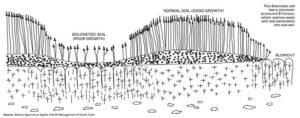
Solonetzic soils have B horizons within 20 centimeters of the soil surface that were formed from saline parent material in ancient ocean beds. Limitations from solonetzic soils are influenced by the chemical properties of the elements in the soil.
Sodium is a positively charged atom that attaches to the outside of a clay particle but does not leave much space for water molecules to attach. The sediments high in sodium and clay, form a layer of soil that is restrictive to water absorption and root growth. This is why solonetzic soils do not infiltrate and store water well, often swelling to a sticky, compact mass when wet.
Chernozemic soils on the other hand are richer in calcium, which has a stronger positive charge, that attaches to clay particles in a 1:2 ratio. This leaves more space for water molecules to attach to the clays and have a better water holding capacity.
OTHER SOILS
Other soil orders found within the Special Areas locally are Gleysolic and Regosolic soils.
Gleysols are periodically or permanently saturated with water and depleted of oxygen. They occur commonly in shallow depressions in association with other classes of soil on slopes and hills.
Regosols are too weakly developed to meet the limits of any other order. The absence or weak development of top soil
is a result from a lack of time for development or from instability of materials. Regosols are found in fluvial landscapes of sand deposits that are reworked by wind action to form eolian formations, or sand dunes, as well as river breaks and eroded hill sides.
Understanding the develop of the soil on your land can lead to better soil management and recognizing the production capacities of the soils.
In future articles, we will discuss how these characteristics will influence plant growth and forage/ crop production.