


26 Mar The Prairie Two-Step: The Sharp Tail Grouse Dance Season
By Nolan Ball, Special Areas Board Agrologist
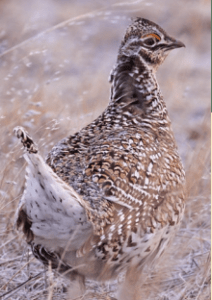
PC: Alberta Conservation
As spring arrives, for dance dads like me it’s spent travelling the highways to support and be entertained at our children’s dance festivals, but this is not the only dance that is happening on the prairies in the spring.
The Sharp-Tailed Grouse (Alberta’s Prairie Chicken), will soon be congregating on the open grasslands, intermixed with shrub and tree patches in dancing fashion. The dancing activity on common grounds is called “Leks”. It is a display of courtship by the males showing off their “dancing abilities” to their female friends. Most activity at the leks occurs in the early mornings, just before sunrise and for a few hours afterwards. The form of competition in this affair is a nearly winner-take-all, as only a few males are selected as mates by the females. Once females seek out a male, breeding and nesting occurs in late April to early May in suitable cover of dead, dry grasses, often at the base of buckbrush, rose or wolf willow patches nearby the lek.
Both males and female birds are identified by their short, pointed tail feathers and bright yellow-orange combs over the eyes. Males feature an added unique purple sac on each side of their neck, which they inflate during courtship. If danger arrives, these colors can be hidden behind feathers to blend in with the brown, dormant landscape.
Nesting habitat success is higher in areas of good quality continuous native habitat. The ideal cover from predators and lower human interaction on the landscape makes the grasslands in the Special Areas an important part of the Sharp-Tailed Grouse’s range.
Although Sharp-Tailed Grouse are not listed as an endangered species, the leks and nesting areas are protected by legislation to ensure survivability of the birds and maintain their populations. Hunting of Sharp-Tailed Grouse has been a past time for many generations, including Indigenous that relied on them as a secure food source. The Sharp-Tailed Grouse is listed as a sensitive species under the Alberta Wildlife Act, indicating the birds don’t like a lot of activity in the vicinity of their lekking grounds, especially during breeding seasons.
Stewarding landscapes that have known Sharp-Tailed Grouse leks involves reducing activity during late March to early May to allow the birds space and sereneness.
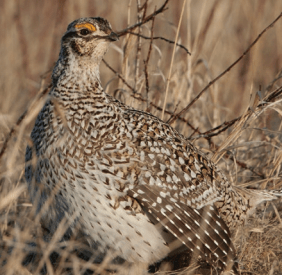
PC: Alberta Conservation
Where there is a known lek, setbacks have been put in place:
- Industrial activities during this time involve restrictions of high impact disturbances within 500m of a known lek
- Focusing low and medium impact disturbances within 500m of a lek to between 10 am and 4 pm
- Ensuring noise decibels are kept to a minimum within 500m of a lek
- Not placing equipment with perching abilities for predators within 500m of a lek.
Land managers can co-exist with the grazing activities within a Sharp-Tailed Grouse habitat by retaining healthy native grasslands and shrubby areas. Avoid grazing native grasslands between mid-March and mid-June, keep fences on the landscape to a minimum, use markers on the top two wires of fences to avoid collisions with birds, avoid winter feeding and heavy grazing in coulees, and controlling cattle grazing in riparian areas.
For more information on the Sharp-Tailed Grouse and the Prairie Two-Step, check out this Alberta Conservation Association’s resource.